

Buyer Guide
How to count plastic bags per kilo
Plastic is bought by the kilo but used by the sheet. With one simple formula you can find the price per sheet and how much you could save in a year.
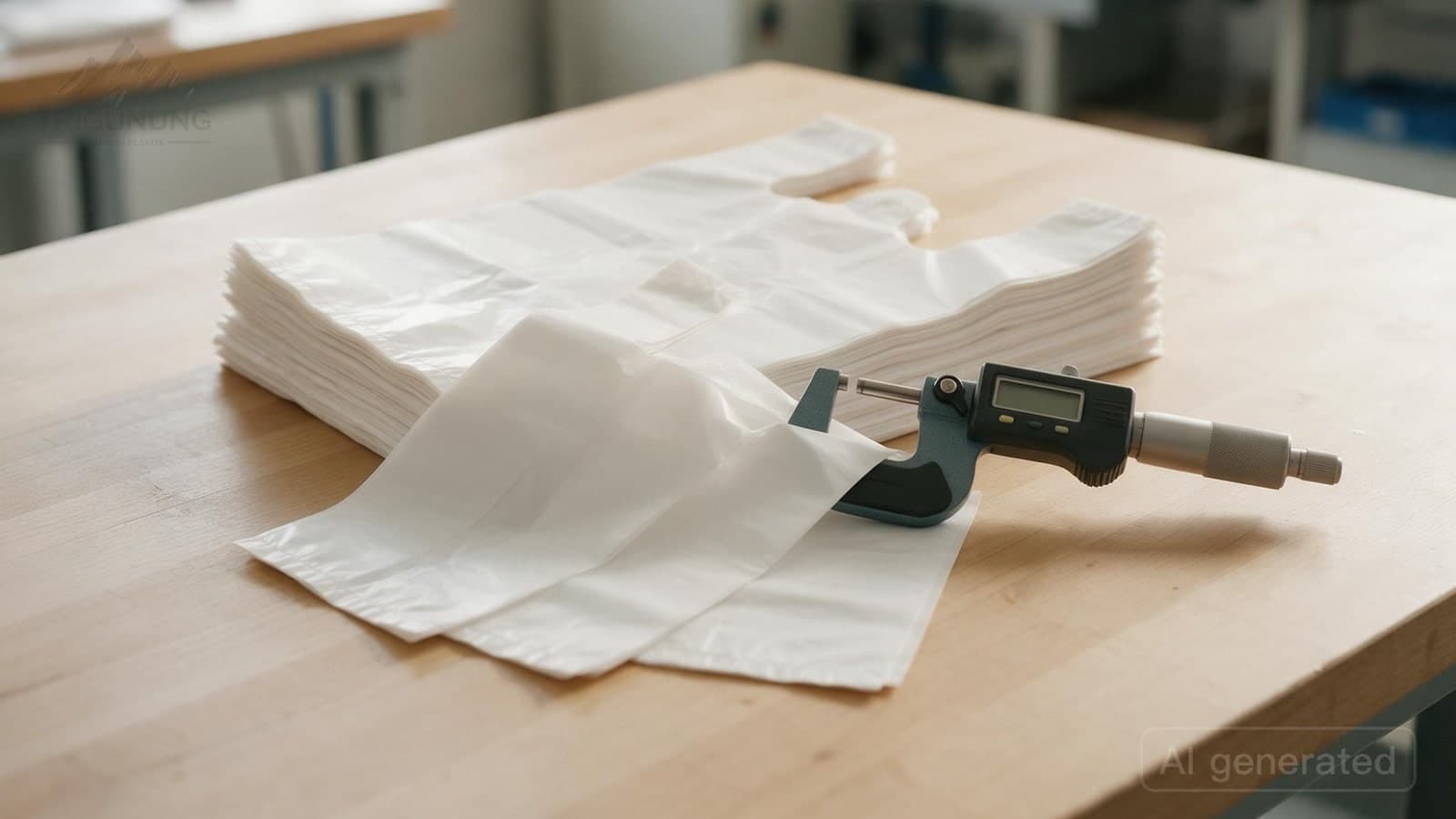
Almost all plastic bag buyers compare prices per kilo. That's fair, since plastic is sold by the kilogram. But in stores, kitchens, or warehouses, plastic isn't used by the kilo. It's used one sheet at a time.
This is where many businesses unknowingly pay more. A low price per kilo isn't necessarily a low price per sheet. The good news is that you can calculate it yourself with just a calculator.
Why sheets per kilo matter
Two bags of the same size can have different weights because their thicknesses differ. Thicker bags weigh more, so a kilo contains fewer of them. Thinner bags weigh less, so a kilo contains more.
So what you're actually paying for is the price per sheet, not the price per kilo.
What you need to prepare
Measuring thickness with a thickness gauge
You should verify the thickness figures provided by the supplier yourself. The tool is called a thickness gauge, or thickness measuring device. It clamps the plastic between two flat surfaces, and the needle indicates the plastic's thickness.
Check the tool's scale:
Bag thickness is only a few hundredths of a millimeter, for example, 0.020 mm in the calculation example below. With a 0.01 mm scale, it's hard to distinguish between 0.020 mm and 0.024 mm.
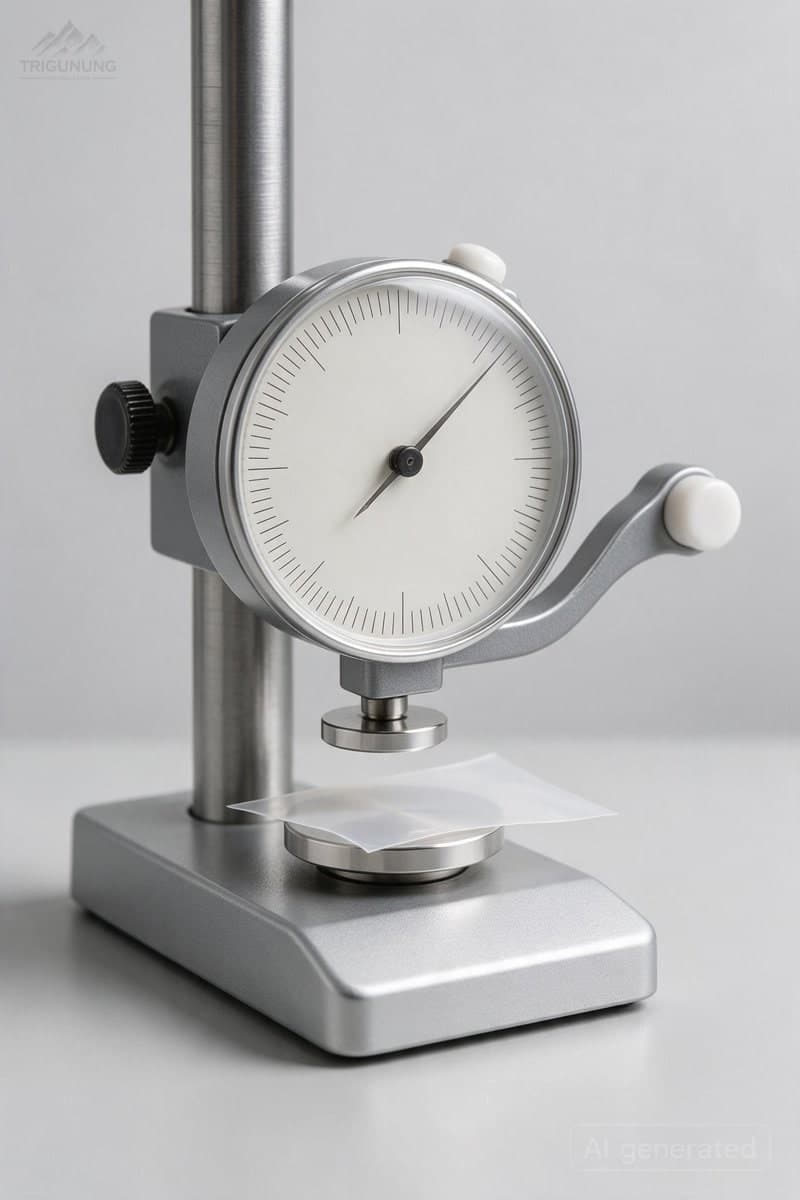
How to use it:
- Zero the tool first, without any plastic inside.
- Measure one layer of plastic. If you're clamping an intact bag (two layers), divide the result by 2.
- Measure at 3 to 5 different points, then take the average.
Plastic material density
Density is the weight of one cubic centimeter of material, in grams. The figures used in this article are common mid-range values:
The formulas
Thickness is usually written in millimeters. Convert it to centimeters first by dividing by 10, so 0.02 mm equals 0.002 cm.
The number 2 in the first formula is used because bags have two sides, front and back. For single sheets, such as liner plastic or cut rolls, the number 2 is not used.
Calculation example
Suppose you're comparing two offers for HDPE bags sized 30 x 50 cm. The prices below are examples only, not a price list.
Offer A, cheaper per kilo:
Offer B, Rp2,000 more expensive per kilo:
Result: Offer B contains 20 percent more sheets per kilo. Even though it's Rp2,000 more expensive per kilo, the price per sheet is actually about Rp26 cheaper, saving around 11.6 percent.
Calculated over a year
Suppose your business uses 1,000 bags per day:
Yet initially, Offer B appeared more expensive.
One note to avoid misunderstanding: "20 percent more content" is not the same as "20 percent savings." If the price per kilo is exactly the same, 20 percent more content means about 16.7 percent savings per sheet. If the price per kilo differs, as in the example above, just calculate it using the formulas.
Cheap must be strong enough
Thinner bags only save money if their strength is still sufficient for your goods. If they tear often, you pay for the wasted sheets too. How to check this is in the article Plastic getting thinner? Check it yourself in 5 minutes, and a full explanation of price per kilo vs. per sheet is in Cheap per kilo, expensive per sheet.
Conclusion
Don't just buy the cheapest per kilo. Ask suppliers to list the size, thickness, and material type, then calculate the price per sheet. Five minutes of calculation can mean millions of rupiah in savings per year.
Want help calculating?
Send us the size, thickness, material type, and purchase price of the bags you currently use. Our sales team will help calculate the price per sheet. Contact us via WhatsApp, or first check out our versatile HDPE plastic bags.